For Garmin watches
Seven purpose-built screens, calorie math that counts every pound in your pack, and a treadmill mode that works when GPS doesn't. Built for ruckers, hikers, backpackers, and vest walkers.
One-time purchase. No ads, no account, no phone app, no subscription.
Why RuckTrack
Garmin's built-in Walk and Hike profiles don't know how much weight you're carrying, so they under-credit a loaded ruck by roughly 10 to 20 percent, and more as the weight and the hills grow. RuckTrack uses the Pandolf load-carriage equation, the model validated by U.S. Army research, to include your pack weight, terrain, and grade in every calorie. See it measured second by second on a real 45 lb climb →
Pandolf math on pack weight, speed, grade, and surface (Road, Gravel, Trail, Sand, Snow). When GPS is iffy or you stop on a hill, RuckTrack falls back to your watch's heart-rate estimate so calories never stall.
An all-in-one Overview, distance, calories with pack bonus, pace and vertical speed, lap data, HR zones, and a clock. Every screen is drawn by hand, with a custom number typeface and color-coded zone arcs. The most polished rucking UX on Connect IQ.
Choose what all six Overview cells show from seventeen metrics, and switch off any live page you never swipe to, before a ruck or partway through one. When an update adds something, a dot on the start screen points at a What's New page explaining what changed.
Two indoor modes. Auto scales your watch's HR-based estimate by pack weight. Manual takes incline and belt speed and runs full Pandolf math. A Saves as setting decides whether the session lands in Garmin Connect as an Indoor Walk or a proper Ruck.
Outdoor sessions classify as Rucking, Garmin's own activity type, not just another Hike, on watches running Connect IQ 5.1 or later. Connect names them descriptively too — "Ruck 35 lb" or "Treadmill Ruck 16 kg" — so your activity list reads at a glance.
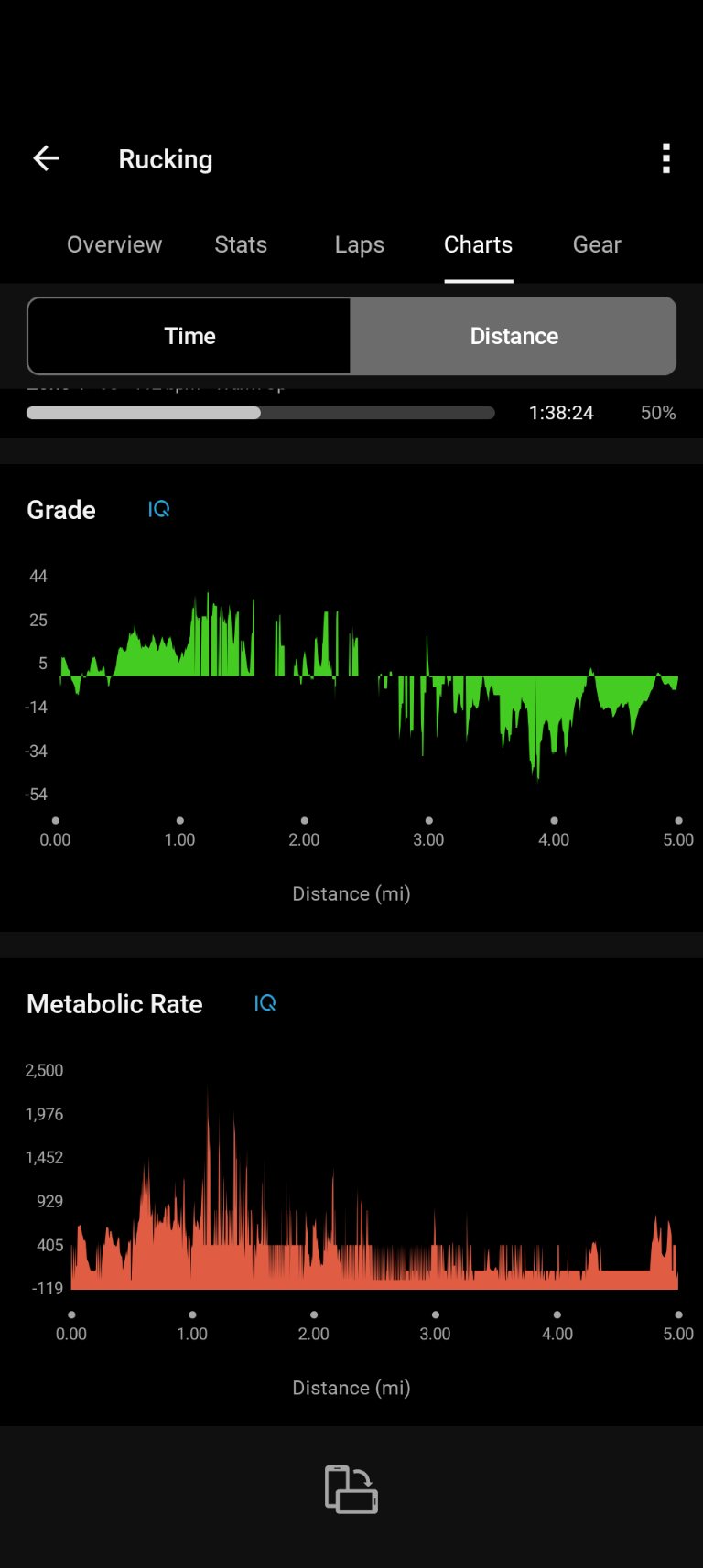
Open any saved ruck on Garmin Connect for grade and metabolic rate plotted second by second, right next to the native pace and heart-rate charts.
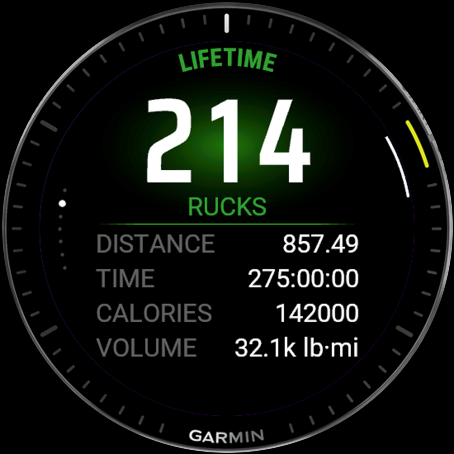
A Stats screen tracks every ruck you save: lifetime distance, time, calories, and tonnage, your weekly streak, and your best pace at three pack-weight tiers. Your history counts from day one.
Every setting, preset, and history entry stays on your watch. No companion phone app, no servers, no analytics, no third-party SDKs.
On the watch
Designed for the way you actually use a watch on a ruck: glance, get the number, look back at the trail. On round watches, page titles and footers curve onto the bezel for a cleaner, more native look.
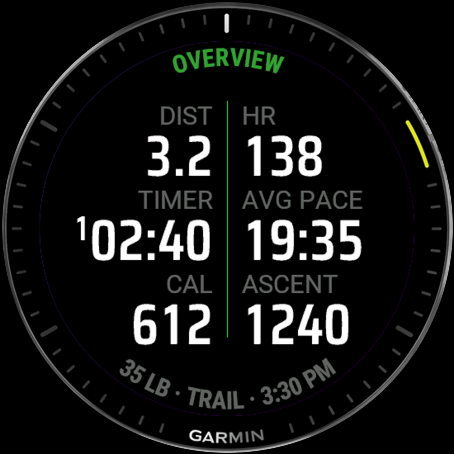
A single page with all your key metrics at once. Distance, heart rate, elapsed time, average pace, calories, and ascent in a clean grid, so you can read the whole ruck at a glance without swiping. Ideal when you just want the full picture in one look.
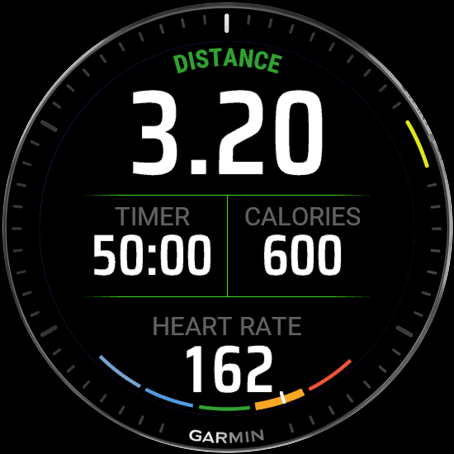
Hero distance, current time and total calories side by side, and a live HR zone arc gauge along the bottom edge. The calorie number on this page is the same one that shows up on the calories page and writes to your FIT file as Ruck Calories.
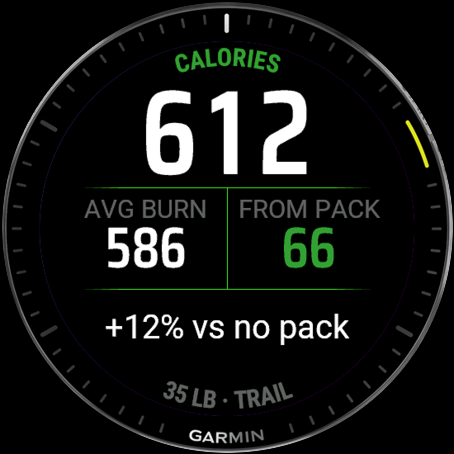
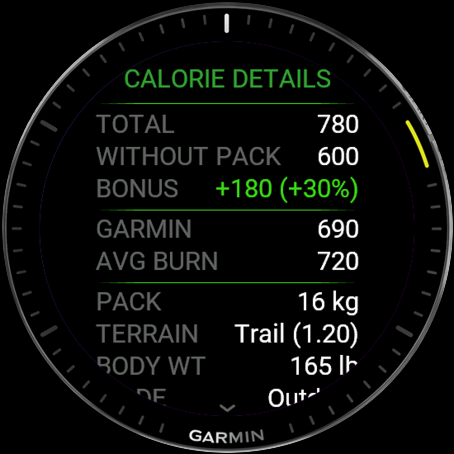
Total calories as the hero. Below it, average burn rate (kcal/hr) and the calories that came from your pack, with a separate "+12% vs no pack" line so you can see how much the weight added. The bottom line shows the pack and terrain.
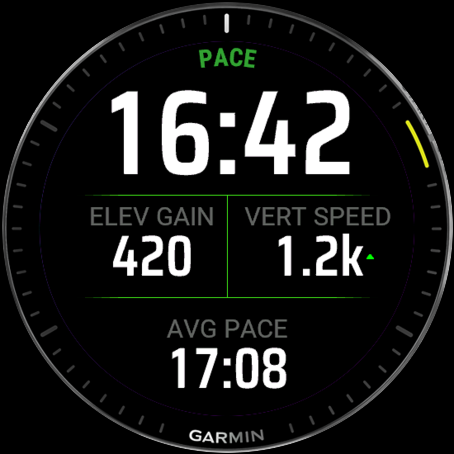
Current pace at the top, total elevation gain and vertical speed in the middle, and overall average pace at the bottom. Vertical speed shows green or red arrows based on whether you're climbing or descending.
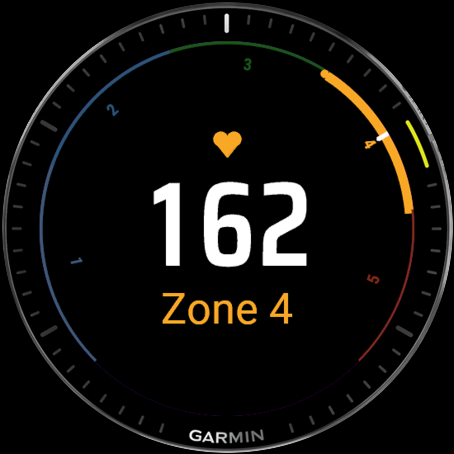
The remaining three pages give you lap data with pace, distance, and time; an HR zones gauge with a pulsating heart icon and circular zone arc; and a clock with battery indicator for when you just want to know how long is left.
When you're done
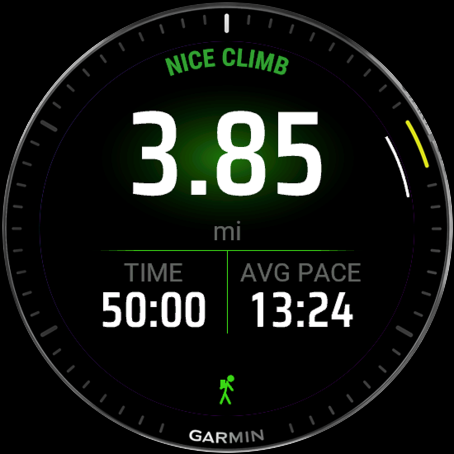
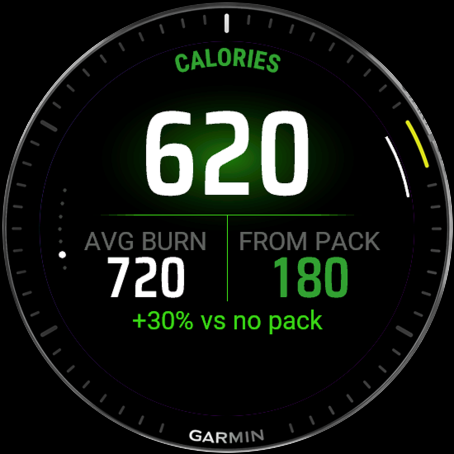
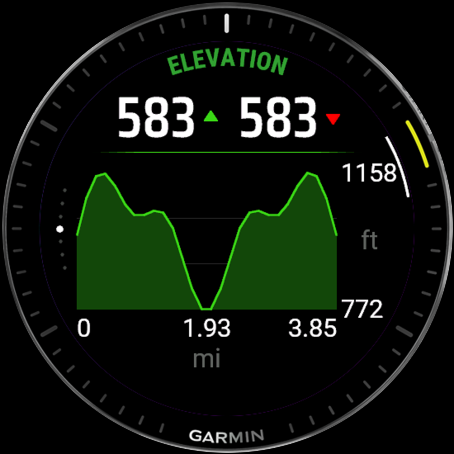
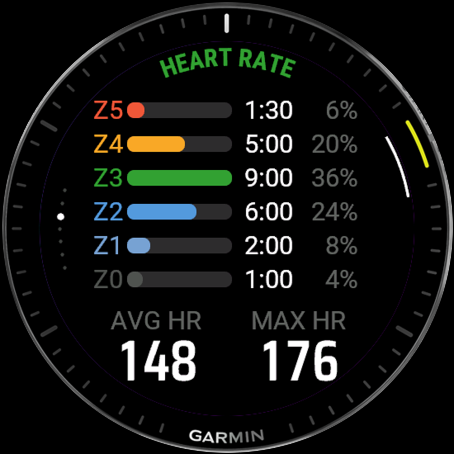
Six or seven pages, depending on the mode. Distance and pace; calories with pack bonus; ruck volume; elevation chart; HR zone breakdown; lifetime totals; and a final pointer to the deeper stats in Garmin Connect.
Overview — distance, time, average pace
Calories — total burn + pack bonus
Elevation — ascent and descent chart
HR zones — color-coded bars + time per zone
Lifetime totals — your cumulative count on this watch
Calorie details — all the numbers
In Garmin Connect
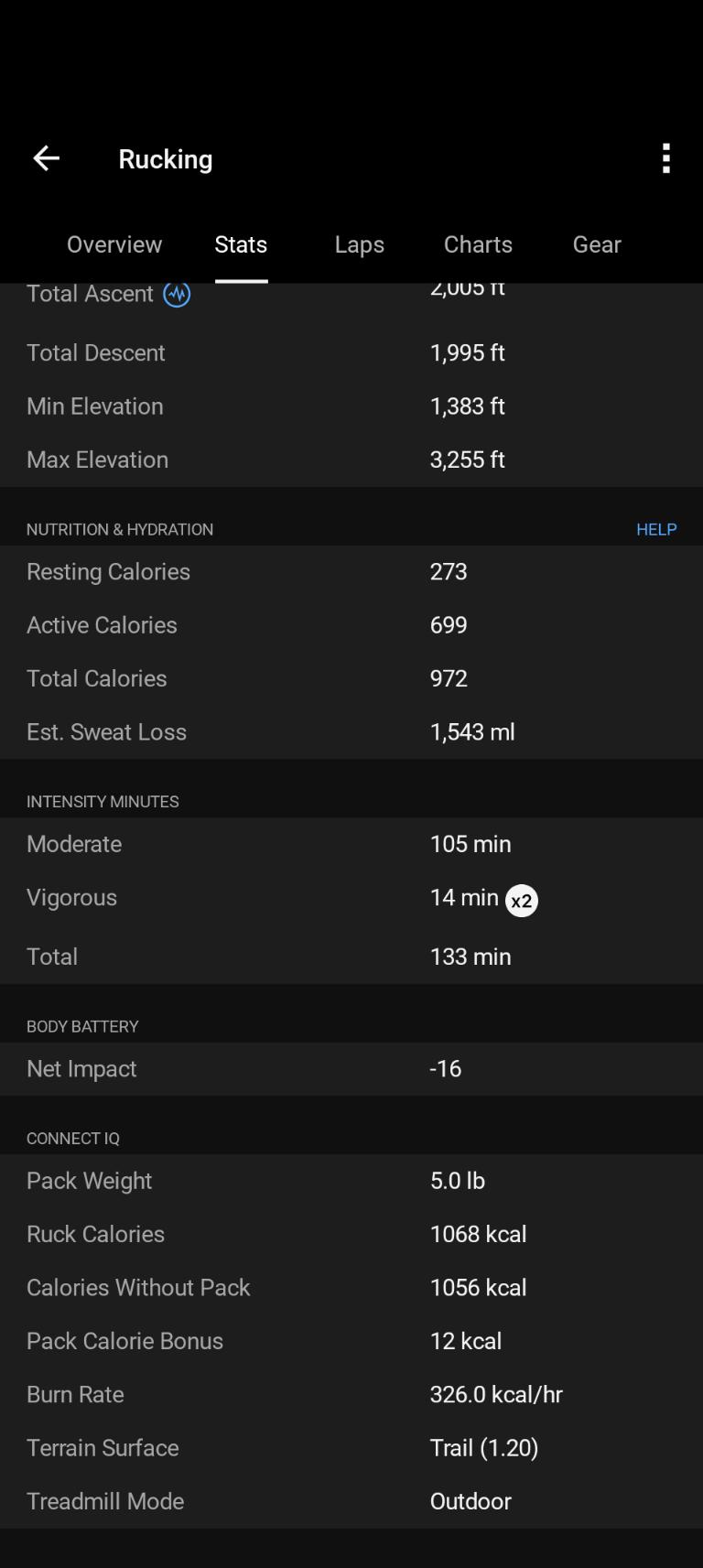
Garmin restricts third-party apps from writing the headline calorie field at the top of an activity, so your load-aware numbers live one section down. Open any saved ruck and look under Stats → Connect IQ for Ruck Calories, Calories Without Pack, Pack Calorie Bonus, Burn Rate, and Terrain Surface. Per-second grade and metabolic rate appear on the activity's chart panel.
Compatibility
Including the Forerunner 165 / 255 / 265 / 570 / 955 / 965 / 970, the fēnix 6 Pro and fēnix 7 families, fēnix 8 / 8E / 8 Solar, fēnix 9 and 9 Pro, Enduro 3, Instinct 3 and Instinct E, Venu 2 / 3 / 4 / X1 / Sq 2, vívoactive 5 / 6, epix Pro, MARQ (first generation and Gen 2), D2 Mach 1 and Air X15, Descent MK3, Mk2 and G2, Approach S50 / S70, tactix 7 / 8, and quatix.
Full device list → or check the Connect IQ Store listing for the live compatibility list.
Install once. Every saved ruck lands in Garmin Connect with the activity classification and load-aware stats your watch couldn't give you before.
Get RuckTrack on the Connect IQ StoreOr try free for 7 days first →
Just want the calorie number in your existing activity? PackCal is the data-field companion →